Tuesday, December 21, 2010

Correcting Bad Media Abroad

www.sun2surf.com

KARTIKA Sari Dewi Sukarno may not know it, but she’s the image of Malaysia in many countries. She may have been a model, but for a few months, she had some claim to fame with her photographs donning newspapers, and in at least one case, the front page. Although she was ordered to be caned for drinking beer, her sentence was commuted to community service after the Sultan of Pahang intervened. But the mere mention of “beer” sends shudders down the spines of foreigners, some of whom out of ignorance think they may get a couple of strokes on the buttocks for drinking beer in Malaysia. And when editors are choosing file pictures to accompany their reports on Malaysia, Kartika’s picture is the pick, accompanied by an appropriate caption.

Why bring up this “old” story, you may ask. Three weeks ago Deputy Foreign Minister Kohilan Pillai told Parliament that Wisma Putra was “monitoring” Malaysians who go abroad and give the country a bad name. Well to be honest, the “bad news” that is emanating from Malaysia is doing much more damage than all overseas Malaysians put together. Forget the so-called critical reports in the Sodomy II trial and the side-shows in and outside the Dewan Rakyat. We can’t go on media-bashing and shouting “biased reporting” every time a negative report is published around the globe. We have to correct the “wrong” reporting, if any, and address the issues of concern that have been raised.

We seem to have fallen into the fallacy that Malaysians tend to forget easily and hence, everyone else has the same trait. Wrong! Malaysia should not be remembered for all the wrong reasons and it is paramount that correct information is given about the country, the government and its people. Forget religious groups calling for the ban of one artiste or another, but the negative reports on Malaysian society as a whole are worrying.

Ten days ago, many newspapers reported that Malaysian authorities confirmed having caned three women convicted of having sex outside of marriage. This has not been helped by a report by the London-based rights group Amnesty International which says “caning in Malaysia has hit epidemic proportions with thousands of people subjected every year to beatings which leave permanent physical and mental scars”. The author of the report, Lance Lattig, says: “According to our figures, more than 10,000 people are caned by authorities in Malaysia annually and this number is actually a conservative estimate.”

How the author arrived at such a figure is unclear, but this report has been circulated worldwide, leading many media organisations to pick it up and use it in their reports, broadcasts and telecasts. Instead of addressing the issue and defending the use of the cane, we have chosen to remain silent. The BBC and hundreds of other media organisations latched on to the stories. Our foreign missions around the world have chosen to ignore the report, believing it will die away.

If this was not damning enough, Associated Press put out this report on its wires, prompting even the Washington Post to pick it up: “A 14-year-old girl and 23-year-old man have celebrated their recent marriage in public in Malaysia’s largest city.” The report said the union was arranged by their parents after obtaining permission from an Islamic court. “It has been hard trying to juggle two roles – as a student and a wife – but I am taking it in my stride,” the report quoted the bride, Siti Maryam Mahmod, who studies at a religious school, as saying.

Ten days ago, this appeared in the New York Times: “The baby boy’s umbilical cord was still attached when a woman and her daughter discovered him crying in bushes underneath a bridge in Tapah, about an hour’s drive north of Kuala Lumpur. Doctors who examined him determined that he was just two hours old. The boy, who has been placed in a children’s home awaiting adoption, is one of nearly 80 abandoned infants who have been found in Malaysia this year, some already dead, prompting much soul-searching and calls for action.”

So, Malaysia is a land where people are caned for drinking beer and having sex outside marriage; we are barbaric in the sense that we use the cane on up to 200 people a week without any reason or rhyme; the leaders condone child marriages; and new-borns are abandoned all over the country.

Can someone stand up and give placid and good explanations for these “negative reports”? Isn’t there anyone in Wisma Putra or our foreign missions who can dispel all these assumed notions about the country and its people? Why do Malaysians have to fly thousands of miles to give their country a bad name when instances of people shooting themselves in the foot and putting their feet in the mouth are available at the press of a button? Instead of “monitoring” Malaysians abroad and their activities, Wisma Putra would be better off taking their overseas officers to task for non-performance of their duties.

MALAYSIA'S DISABILITY

December 21, 2010

People with disabilities are not looking for charity or pity. They just want respect.

DEC 21 — I spent four summers as a counsellor at an Easterseals camp for youth with disabilities. I have worked at many camps, but I especially cherish this experience.

At Easterseals, all doors open automatically, all accommodation are on the ground floor, all vehicles and showers are wheelchair-friendly, the pool has a special lift, sailboats have hammocks with neck support, and everything is connected with a smooth pathway. In other words, campers spend the summer in a world built for them.

After this experience, I became sorry for people who said “poor thing” or “what a tragedy” as they gazed at the campers in my photos. I also felt sorry for the people who got uncomfortable when speaking to my campers, or treated them like babies on field trips.

It bothered me when they stumbled over the “correct” term with which to refer to my campers — when really all that matters is intention. Most of these young people with disabilities were making the best of their lives — something I can’t say for all their able-bodies acquaintances.

From my very first days in Malaysia, it struck me as one of the most inaccessible countries I’ve ever been to. Even compared to poorer countries, Malaysia still ranks at the bottom in this regard. For example, a dirt road in rural Cambodia is much more accessible than a broken busy sidewalk in KL.


Colin Boyd Shafer teaches social science at a college in Kuala Lumpur, Malaysia. Aside from writing/ranting, he concentrates most of his time doing documentary photography, trying to create a dialogue around sensitive issues. You can follow his work at ‘Colinizing Photography’ on Facebook

Development here happened so fast that developers seemed to forget all the people. Malaysia has thrown up tall buildings and mega malls, joined by an extensive highway system. In other words, it is a system designed for those with cars.

The idea that some people like to walk has been ignored. More importantly, those with special needs have been disregarded. I am guessing I am not the only person who has witnessed a disabled man with a walker trying to cross a busy intersection, while cars whiz by as though he doesn’t exist.

The only wheelchair ramp I can find at the Subang Carrefour has a metal pole in the middle (see photograph). Even if 100 buses have been equipped with ramps, are the bus stops equipped as well?

As reported in The Star ”Wheel Power” by Anthony Thanasayan, one wheelchair-bound Malaysian woman said “The total disregard of my local council for disabled-friendly facilities keeps me a constant prisoner in my own house.” Even government buildings such as police stations aren’t always accessible.

It is not like Malaysia is oblivious to the situation. Since the 1990 amendment to the Uniform Building Bylaw of 1984, it is compulsory for all buildings to provide access and facilities to disabled persons.

According to Human Rights Watch and my own observations, compliance with this is at best“sporadic” . What percentage of buildings actually comply with this law?

According to Ding Jo-Ann in theNutGraph, Malaysia signed the Person with Disabilities Act (PWDA) in 2008 under the UN Convention on the Rights of Persons with Disabilities.

This document stated that people with disabilities should have equal access to public facilities, amenities, services, and buildings, public transport, education, employment, information, communication and technology, culture and recreation. Malaysia ratified the treaty in July 19, 2010.

However, Human Rights Watch revealed that Malaysia entered formal reservations to the Convention concerning the prohibition of torture and other ill-treatment (article 15) and the right to liberty of movement and nationality (article 18).

Disability rights Researcher Shandtha Rau Barriga claimed “Malaysia’s reservations are troubling and send a terrible message to people with disabilities... What possible justification could Malaysia have for objecting to protecting persons with disabilities from torture or allowing them to move around the country?” Furthermore, Malaysia has reportedly not signed an “optional protocol” which would allow people with disabilities to report to a UN committee when Malaysia is not complying with the UN Convention!


T
Some Malaysian youth are also disadvantaged within the current policy. As reported in The Daily Express, children are segregated by abilities/disabilities in Malaysia. According to the Education Act of 1996 children are classified as “educable” or “non-educable.” This is preposterous! How can a human being be non-educable?

Still, there is hope. This month Malaysia is competing at the Asian Para-Games in Guangzhou. The Starreported that Mohd Salam Sidik, two-time Olympic archer, would be the flag-bearer for Malaysia. It is great that Malaysia is participating, but what is it like when Mohd Salam Sidik tries to get around KL? Does he feel like he is bearing the national flag as he tries to cross a busy pot-holed intersection?

Many Malaysians are involved in trying to improve the situation of the disabled community. Disability rights advocatePeter Tan has taken it upon himself to revolutionise his community through networking, blogging, and pushing for an independent living centre in KL.

Likewise, Anthony Thanasayan, vice-president of the Support Group Society for the Blind of Malaysia, shares his constructive frustrations and recommendations in The Star Wheel Power column. Yvonne Foong wrote a book about her experience of battling neurofibromitosis, and has her own charity organisation called Heart4Hope.

Improvements have happened in Petaling Jaya where the city council’s (MBPJ) universal design pavement project along Jalan Gasing covers 500m, integrating a church, a temple, a popular park, eateries, and a couple of therapy centres and shops. The country needs more projects like this. Which other council will follow suit?

If disadvantaged citizens have an opportunity to succeed, Malaysia will be a much happier place. When accessibility improves, it benefits everyone. According to the UN, 10 per cent of the global population has some sort of disability. Moreover, we will all spend about eight years of our lives disabled. I may be walking today, but tomorrow may be different.

As with many of my articles, I am trying to encourage people to create positive social change. Readers will not have to look long and hard to find something which needs fixing. No ramp? Ask why. Own a business? Make sure it is accessible. Sidewalk perpetually broken? Demand repairs. If PJ can create positive change, so can other communities. The movement has started, now it just needs more voices.

* The views expressed here are the personal opinion of the columnist.

Sunday, December 19, 2010

INSTANT NOODLES ICON

Indonesia has once again had its integrity outrageously questioned as the harsh, unforgiving spotlight of international standards and regulatory systems is mercilessly shone upon this great nation. This time around, one of the country's most nutritious staple foods, namely instant noodles, has been viciously slandered by the Taiwanese authorities, who have banned the product on the grounds that it contains excessive amounts of the preservative, benzoic acid.


I've long suspected that the plastic wrapper that the classic slab of Indomie comes packaged in contains more nutrients than the noodles themselves do, although I don't have the scientific data in front of me to back that claim up. This latest health scare comes on the back and various other horrors, including Indonesian market traders who douse their fish with formaldehyde in order to keep it looking fresh and free from flies. Personally, I'm not convinced that embalming one's customers is going to bring you a lot of repeat business although perhaps these traders also offer a sideline taxidermy services.


Indomie is an iconic, almost fetishized food here of course, and I have long despaired of ever understanding why it is that some of the country's worst foods, namely instant noodles and the grey balls of inorganic compounds and petrochemical pipeline tailings known as 'bakso' have the public hooked like junkies, when this is surely a land of fresh fruit, vegetables and general nutritional bounty.

Moreover, whenever there's a charity drive here, the food that almost invariably seems to get donated to the poor unfortunates in huge amounts is our old friend, the instant noodle, usually in enormous boxes filled with hundreds of packets. Just lost your house in an earthquake? Then add rickets to your woes by feeding your family on Indomie for a month.


I find it particularly ironic that Taiwan has rejected that toothsome Indomie blend of industrial solvents and unpronounceable chemicals spelt with lots of exes and zeds though, seeing as they invented the bloody stuff in the first place, but you've got to have standards I suppose. Apparently, consuming benzoic acid in large quantities can result in nausea, deterioration in kidney function and possibly metabolic acidosis, a potentially fatal condition.

The Indonesian BPOM (Food and Drug Monitoring Agency) has now declared that Indomie contains safe levels of both benzoic acid and a chemical called p-hydroxybenzoate (which sounds like something that you'd find in superglue). So that's okay then. Well I don't know about the BPOM, but it wouldn't surprise me to learn that they had a rather cozy relationship with the noodle industry.

As a parallel, America's FDA (Food and Drug Administration) are not necessarily a body that I'd entrust my body to. Well under the thumb of its corporate masters, the FDA recently declared walnuts to be drugs and Doritos to be, "Heart healthy." Food and Drug Administration you see. Pig out on McDonalds for 20 years and then get yourself on some pills to try and mitigate the consequences. Double sale! But I digress.

Returning to those errant noodles, let's have a run through some of the ingredients to be found in a typical packet that I bought at a branch of Circle K this week. I stared intently at the shelves on my visit perusing the various varieties on offer: Rubber and Sand flavor, Pencil Shavings and Axle Grease flavor, Nothing flavor. Eventually however, I plumped for a yellow packet of Kari Ayam flavor. So how did the ingredients break down?

Tartrazine: this yellow food dye has been linked with hyperactive disorders in children and has now been phased out in a number of European Union countries. In the 1990s, a myth began circulating that excessive tartrazine consumption could affect male potency and penis size, however there are no documented cases confirming this hysterical rumor. In fact, on the contrary, I'd say that East Asian gentlemen are positively hard for tartrazine laced noodles.

Tartrazine

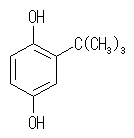
TBHQ: this is a preservative used for unsaturated vegetable oils and is also found in varnishes, lacquers and resins (whoa!). Some studies have suggested that the substance might be mildly carcinogenic, but who cares when your insides look as shiny as a freshly polished Chesterfield.

TBHQ

MSG: everyone knows this one of course. This nuclear powered flavor enhancer (something like sodium chloride mixed with uranium) is an East Asian staple. MSG is seen as the bogeyman of instant cuisine and modern dietary habits, although strict double-blind medical trials have yet to show conclusively that the stuff can cause obesity or worsen symptoms of asthma, and MSG has now been pretty much declared medically safe. Also of course, without a healthy whack of MSG, Indomie would taste like, well, nothing at all I guess.

MSG

Benzoic Acid: this stuff actually occurs naturally in cranberries and bilberries, however too much of it is bad for the liver and kidneys.

Benzoic Acid

So there we have it folks, a few health issues to a mull over, although perhaps the time-honoured tradition of breaking an egg into the noodles and tipping half a bottle of chilli sauce into the mix serves to neutralize these latent dangers. In any case, I'm starting to feel peckish...

METRO MAD JAKARTA

MENJAGA HUBUNGAN SILATURRAHIM

Dalam hadis diriwayatkan Imam al-Bukhari dan Muslim bermaksud: “Daripada Anas Malik r.a bahawa Rasulullah SAW bersabda: Sesiapa yang suka (dan ingin) dimurahkan rezeki serta dilewatkan ajalnya, hendaklah dia menghubungkan silaturahimnya.”

Maksud silaturahim ialah berbuat baik kepada kaum kerabat. Disebabkan inilah perkataan silaturahim (menghubungkan ikatan kekeluargaan) diguna dengan maksud berbuat baik kepada sanak saudara.

Hubungan kekeluargaan dapat dijalin melalui harta, khidmat atau sebagainya yang menjadi sebab diberi taufik melaksanakan ketaatan dan dipelihara daripada melakukan maksiat dalam hidup. Justeru, lahir pujian selepas seseorang meninggal dunia. Pujian itu bagaikan umur kedua untuknya.

Bagaimanapun, jelas ajal tidak ditangguh kerana Allah SWT berfirman dalam surah al-A’raf ayat 34 bermaksud: “Maka apabila ajal sudah datang, mereka tidak dapat menangguhnya (walaupun) satu detik dan tidak juga dapat mendahulukannya.”

Firman-Nya lagi dalam surah al-Munafiqun ayat 11 (bermaksud): “Allah tidak akan menangguh kematian sesuatu yang bernyawa (sama ada manusia atau lainnya) apabila ajalnya sampai.”

Oleh itu, maksud ajal dilewatkan dalam hadis berkenaan adalah pujian kepada orang yang menghubungkan silaturahim berkekalan selepas kematiannya. Seolah-olah dia belum mati.

Namun, ada ulama yang menghukum pandangan ini lemah. Antaranya ialah Imam an-Nawawi r.h.m dalam kitabnya Syarhu Muslim ketika menghuraikan hadis itu. Menurut beliau, ulama mengutarakan beberapa jawapan dan huraian kepada persoalan dilewatkan ajal bagi sesiapa yang menghubung silaturahim.

Pertama, jawapan yang benar ialah tambahan ajal adalah dengan keberkatan umurnya, diberi hidayah untuk taat, dipenuhkan masa hidupnya dengan perkara berguna kepadanya di akhirat, dipelihara waktunya daripada sia-sia dan seumpamanya.

Kedua, tambahan ajal itu berdasarkan apa yang zahir kepada malaikat seperti tertulis di Luh Mahfuz dan seumpamanya. Sebagai contoh, malaikat mendapati di Luh Mahfuz umur seseorang ialah 60 tahun, tetapi jika dia menyambung silaturahim, umurnya ditambah 40 tahun lagi. Padahal Allah SWT mengetahui apa yang terjadi. Berdasarkan ilmu dan takdir Allah SWT, tambahan ajal adalah mustahil, namun berdasarkan apa yang zahir kepada malaikat, ia tidak mustahil.

Ketiga, ialah tambahan umur bermaksud kekalnya sebutan dan pujian yang baik selepas kematian seseorang seolah-olah dia masih hidup. Boleh jadi sebutan yang baik itu disebabkan ilmu yang bermanfaat atau sedekah jariah (seperti wakaf) atau anak solih yang mendoakannya.

Dalam kitab al-Mu’jam as-Saghir, karangan at-Thabrani, diriwayatkan daripada Abu Darda: “Disebutkan di sisi Rasulullah SAW bahawa sesiapa yang menghubungkan silaturahimnya, ajalnya akan ditangguh untuknya. Lalu Baginda SAW bersabda: Ia bukanlah tambahan umurnya kerana Allah SWT berfirman (dalam surah al-A’raf ayat 34 bermaksud): Maka apabila ajal mereka datang, mereka tidak akan dapat melewatkannya walaupun satu detik dan mereka juga tidak akan dapat mendahulukannya. Tetapi lelaki itu mempunyai zuriat salih yang berdoa untuknya selepas kematiannya.”

Justeru, menghubungi silaturahim ialah punca rezeki dimurahkan dan pujian yang akan mendorong orang masih hidup memohon rahmat Allah SWT dan berdoa perkara yang baik untuk si mati berkenaan. Wallahua’lam.

INFO:
SEBARANG kemusykilan sila hantarkan soalan ringkas menerusi e-mel bminggu@bharian.com.my atau melalui pos di alamat Berita Minggu, Berita Harian Sdn Bhd, Balai Berita, 31, Jalan Riong, 59100 Bangsar, Kuala Lumpur

Friday, December 17, 2010

OTHER WIKILEAKS CABLES

WikiLeaks cables: UK's anti-drugs fight in Ghana 'beset by corruption'

US diplomats claim corruption in Ghana has ruined costly UK-funded anti-drugs smuggling operation

A British operation to stem the flow of cocaine through Ghana has been beset by corruption, with local drug police sabotaging expensive scanning equipment and tipping off smugglers to avoid detection, leaked US embassy cables reveal.

Ghana's president, John Atta Mills, even worried that his own entourage may be smuggling drugs through his presidential lounge at Accra's Kotoka airport, and asked a senior UK customs official in November 2009 for help to screen them "in the privacy of his suite to avoid any surprises if they are caught carrying drugs", according to the US embassy in Accra.

The request reveals a deep crisis in the bilateral operation against wholesale drug trafficking into the UK through an airport which has become one of the main transit hubs for South American drug cartels after the authorities successfully blocked routes from the Caribbean.

Operation Westbridge has so far cost the taxpayer more than £1m and more than £100m worth of drugs has been seized amid growing UK concern that drug trafficking is becoming institutionalise in west Africa. The UN has estimated that up to 60 tonnes of cocaine, worth £1.3bn, are being smuggled through west Africa, mostly into Europe, each year.

According to the cables, Ghanaian narcotics control board (Nacob) officers working with British officials:

• Actively helped traffickers, even calling the criminals on their mobile phones to tell them when to travel to avoid detection.

• Sabotaged sensitive drug scanners provided to the Ghanaian government.

• Channeled passengers including pastors and bank managers and their wives, into the security-exempt VVIP lounge despite suspicions they were trafficking drugs.

Smuggling has become so blatant that on one flight last year, two traffickers vomited drugs they had swallowed and subsequently died, while parcels of cocaine were found taped under the seats of a KLM plane even before boarding.

Roland O'Hagan, the British head of Operation Westbridge, reportedly told the US embassy: "President Mills had expressed interest in acquiring itemisers [portable screening devices] for the presidential suite at the airport in order to screen his entourage for drugs before boarding any departing flight."

Mills had publicly pledged to crack down on wholesale drug trafficking into the UK via the airport and won the presidency on an anti-drugs platform. But, in June 2009, he told the US ambassador to Ghana, Donald Teitelbaum, "elements of his government are already compromised and that officials at the airport tipped off drug traffickers about operations there".

Embassy contacts in the police service and the president's office "have said they know the identities of the major barons," but "the government of Ghana does not have the political will to go after [them]", a December 2007 cable said.

A UK official overseeing Westbridge had observed Nacob agents at the airport directing passengers away from flights receiving extra scrutiny, a cable from the US embassy in Accra revealed in August 2008. "On one occasion, [the official] returned unexpectedly to the airport at 4am to screen a flight. An arrested trafficker told the UK official that the trafficker had been told that Westbridge was not operating that night. A test by Westbridge officials of the mobile phone sim card of a trafficker found the phone numbers of senior Nacob officials."

He said two itemisers were incapacitated by sabotage, remarking that "the knowledge required to remove the filters exceeded the basic knowledge of the operators".

The cable concluded: "The government of Ghana does not provide the resources necessary to address the problem and, at times, does not appear to have the political will to go after the major drug barons."

Operation Westbridge began in November 2006, overseen by the Home Office and Foreign Office, and the government has trumpeted its success. Last year, the Home Office minister responsible for tackling drug trafficking, Alan Campbell, told a parliamentary inquiry that the scheme was a "very good example" of how to tackle the cocaine trade, while in a written statement, the Home Office said "these operations meet our drugs strategy commitment to intercept drugs and drugs couriers before they reach the UK".

In the confidential cables, a different picture emerges. Kim Howells, Labour foreign office minister, delivered a "stern message" to the Ghanaian government in October 2007 about its lack of co-operation and responded "testily" to a request from Ghana's interior minister for more scanning equipment, saying "if a 'criminal' is operating equipment, it is worthless," according to the US embassy in Accra.

Three months later, the embassy reported that "seizures in Accra drop to almost zero when the Westbridge team …is back in London".

In November 2009, O'Hagan told the US embassy that Nacob believes the airport's VVIP lounge has been a conduit for drugs leaving the country. Bank managers, pastors, and their wives were among those given official passports and access to the lounge which circumvents security checks, the embassy reported.

"Nacob placed two officers in the lounge to screen departing passengers, and the number of passengers using the VVIP lounge has decreased," the embassy reported O'Hagan saying late last year.

Credit: www.guardian.co.uk